We put five USB 3.2 flash drives from Kingston, PNY, Samsung, and Sandisk to test. They all come from reliable brands that have been in the flash drive business since the inception of the product category. For this round-up, we kept the focus on USB-C thumb drives that strike a usable balance between form factor, capacity, and real-world transfer speed — plus one hardware-encrypted outlier for readers who need the drive itself to be the lock.
For those of you who value size over speed, mini USB drives serve well as semi-permanent storage for your laptops. Likewise, if you need a drive for data exchange between USB-C and legacy USB ports, dual-headed flash drives are just what you need but speeds don’t match the ones featured in this article.
Editor’s Choices
Assuming you have the right port (i.e. USB 3.2 Gen 2×1) to match, Sandisk Extreme PRO is hard to beat for large and small file jobs alike. In our 10GB MP4 test, it led the pack at 776.91MB/s read and 599.55MB/s write, while also posting the fastest photo folder read at 686.56MB/s. Available in capacities from 256GB to 2TB, its aluminum alloy chassis features a smooth, reassuring USB slider mechanism. The drive is also backed by a lifetime warranty along with consistently better pricing and availability.
PNY PRO Elite V3 finishes a close second in overall throughput, trailing just behind the Sandisk Extreme PRO. Between the two, the PNY is a tad smaller and even has an arguably better designed retractable connector. Our main caveat is its a two-year warranty — the shortest in this comparison.
Alternatives
The Kingston DataTraveler Max — our previous Editor’s Choice — is now five years old, and availability is extremely limited. Even though its speed remains competitive, newer rivals offering sturdier build quality have since superseded it. As for Samsung, its low-profile USB-C flash drive delivers acceptable performance for its size, but RAMageddon-driven price hikes make it much less appealing.
Feature Comparison
 Kingston DataTraveler Max Price not available for 512GB |  Kingston IronKey Keypad 200 Price not available for 256GB |  PNY PRO Elite V3 $239.99 for 512GB |  Samsung USB Type-C Drive $145.99 for 512GB |  Sandisk Extreme PRO $134.99 for 512GB |
|
| Connector: | USB-C | USB-C | USB-C | USB-C | USB-C |
| Storage: | 256GB - 1TB | 16 - 512GB | 256GB - 2TB | 64 - 512GB | 256GB - 2TB |
| Interface(s): | USB 3.2 Gen 2 (10Gbps) | USB 3.2 Gen 1 (5Gbps) | USB 3.2 Gen 2 (10Gbps) | USB 3.2 Gen 1 (5Gbps) | USB 3.2 Gen 2 (10Gbps) |
| UASP? | Yes | No | Yes | No | Yes |
| Movie Read: (10GB MP4) | 725.08MB/s | 152.37MB/s | 747.97MB/s | 349.07MB/s | 776.91MB/s |
| Movie Write: (10GB MP4) | 552.52MB/s | 128.01MB/s | 595.45MB/s | 108.86MB/s | 599.55MB/s |
| Photo Read: (10GB JPEGs) | 527.08MB/s | 147.73MB/s | 582.71MB/s | 275.48MB/s | 686.56MB/s |
| Photo Write: (10GB JPEGs) | 364.49MB/s | 105.13MB/s | 347.59MB/s | 87.27MB/s | 336.76MB/s |
| Retractable Connector? | Yes | No | Yes | No | Yes |
| Dimensions: | 82.2 x 22 x 9mm | 80 x 20 x 11mm | 57 x 19 x 6mm | 33.7 x 15.9 x 6.4mm | 80.8 x 18.3 x 11.43mm |
| Build Material: | Plastic | Aluminium | Metal | Plastic | Aluminum alloy |
| IP Certified? | IP68 | ||||
| Color(s): | Black | Metallic blue | Black | Blue & dark grey | Grey |
| Software: | None | None | None | None | SanDisk Memory Zone |
| Aug 2021 | Aug 2023 | Feb 2025 | July 2022 | Nov 2025 | |
| Warranty: | 5 years | 3 years | 2 years | 5 years | Lifetime |
Pricing is last updated by Amazon on 2026-09-15 at 10:34. When you buy through Amazon affiliate links on our site, we may earn an affiliate commission.
Benchmark Analysis
Our tests were carried out using Nodesoft’s DiskBench on a MacBook Pro equipped with 10Gbps USB-C ports. Even on laptops with USB4, a USB-C port alone doesn’t ensure maximum throughput; speed ultimately hinges on whether the drive uses a 5Gbps (Gen 1) or 10Gbps (Gen 2×1) USB 3.2 interface.
In our 10GB MP4 single-file movie benchmark, the SanDisk Extreme Pro USB-C took overall honors, achieving an impressive 776.91MB/s read and 599.55MB/s write speed. The PNY PRO Elite V3 trailed just behind, posting a near-identical write throughput of 595.45MB/s and a 747.97MB/s read speed. The Kingston DataTraveler Max also demonstrated strong 10Gbps performance, turning in 725.08MB/s read and 552.52MB/s write.
On the 5Gbps side of the field, bandwidth limits become immediately apparent: the compact Samsung USB Type-C Flash Drive topped out at 349.07MB/s read and 108.86MB/s write, while the security-focused Kingston IronKey Keypad 200—which prioritizes PIN-based encryption over raw speed—recorded 152.37MB/s read and 128.01MB/s write.
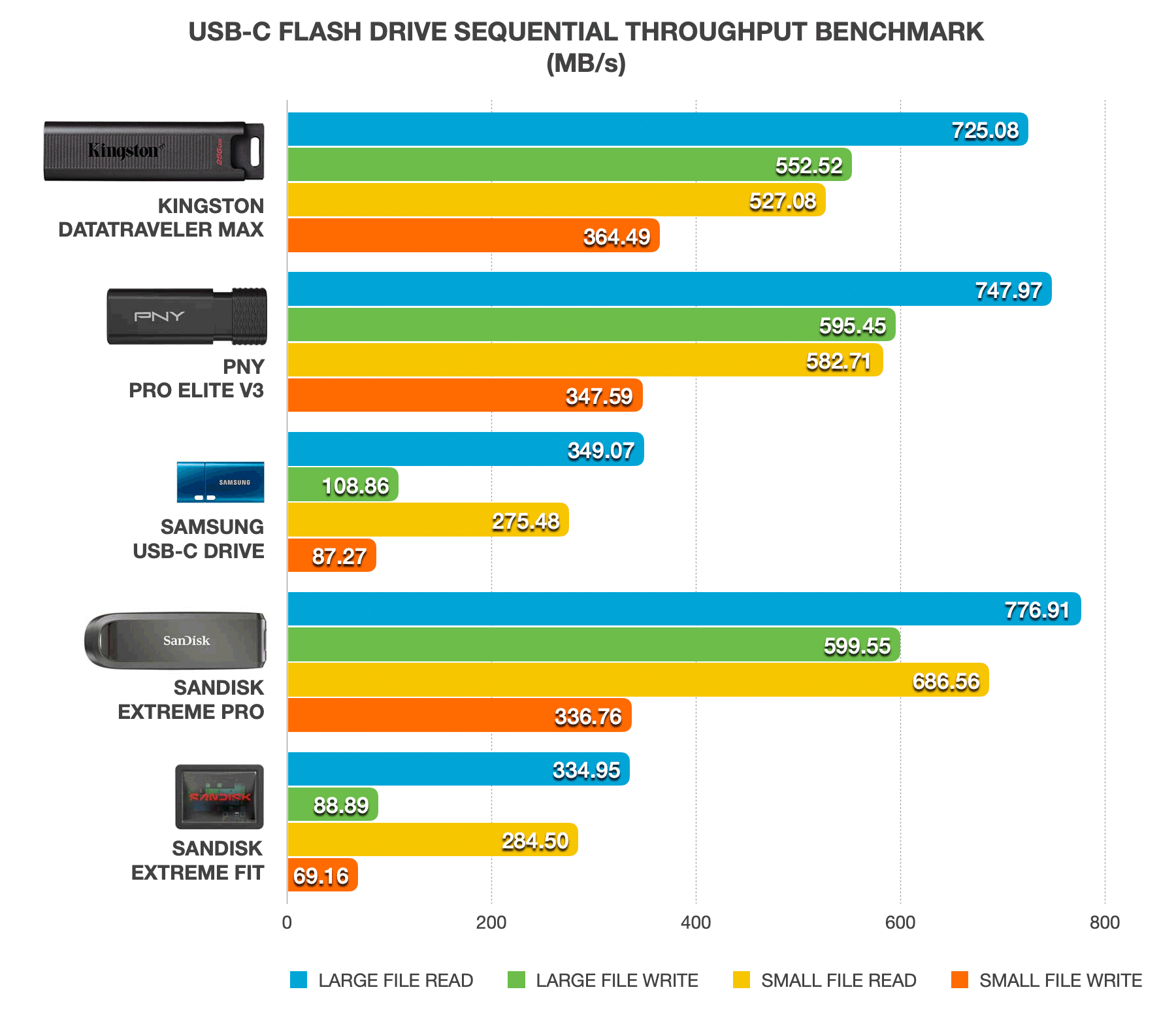
To measure performance during bulk small file transfers, our second test involved moving a 10GB folder of JPEG photos to and from each drive. The SanDisk Extreme Pro maintained its lead in small file read operations at 686.56MB/s, followed by the PNY PRO Elite V3 at 582.71MB/s and the Kingston DataTraveler Max at 527.08MB/s. However, the Kingston DataTraveler Max claimed first place for photo write operations, hitting 364.49MB/s to narrowly beat out PNY (347.59MB/s) and SanDisk (336.76MB/s).
Rounding out the comparison, the Samsung USB Type-C drive managed 275.48MB/s read and 87.27MB/s write, while the Kingston IronKey Keypad 200 completed the benchmark with 147.73MB/s read and 105.13MB/s write. These tests are crucial as manufacturers don’t normally advertise benchmarks for small file operations.
Design & Build
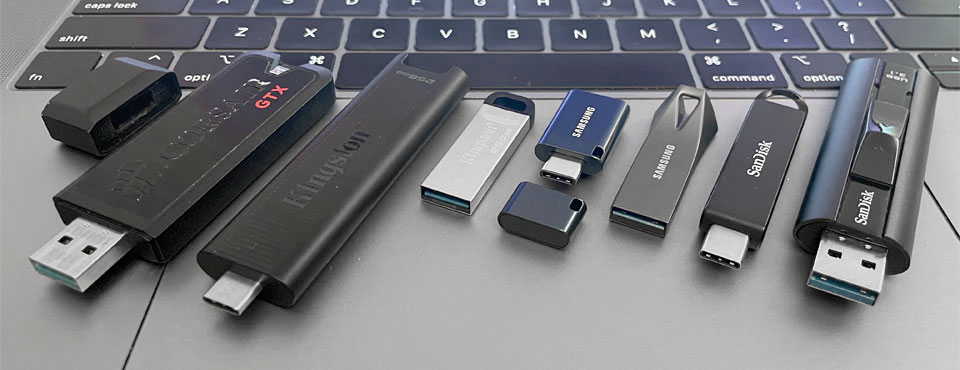
Design-wise, the Corsair Flash Voyager GTX’s zinc alloy body adds to its toughness as well as weight. It is clearly built to take a beating, suffice to say. The flash drive should be able to easily survive after a drop or after being run over by a vehicle occasionally. Our only gripe with the chassis is that it’s very prone to scratches which make the drives lose some of their appeals over time. It’s worth mentioning that the Corsair has a wider-than-normal profile which poses a problem in accessing horizontally adjacent ports. Corsair opts for a removable metallic cap that fits snugly with the drive’s USB plug – thanks to the cap’s rubber seal interior.
In contrast to the Corsair, Kingston DataTraveler Max is an all-plastic affair. We had hoped Kingston opts for more premium building materials that add durability to the drive’s body. The unit comes with a retractable USB-C plug as well as a keychain loophole. In terms of size, the DataTraveler Max is slimmer and lighter than the Flash Voyager GTX. It is significantly wider than other USB-C drives reviewed here. Hence, plugging the DataTraveler Max into a laptop will likely block access to a neighboring port if there’s one.
As for the Samsung line-up, the Bar Plus sports a minimalist aluminum alloy body with a Type-A port. Its much smaller sibling comes with a USB Type-C port and is encased in a plastic body.
Moving onto Sandisk’s offerings, the contoured-shaped Extreme Pro goes with the company’s tried-and-true USB slider mechanism with an outer shell that is made of metal alloy to improve its durability. Its minimalist cousin – Ultra USB-C drive – is however built with flimsy plastic material and its slide-out connector mechanism leaves something to be desired. Lastly, Lexar JumpDrive M900 has a retractable plug design and build quality similar to that of the Sandisk Extreme Pro but you will find an activity light on the Lexar.
iPad users may want to know the Sandisk Ultra USB-C is the only flash drive featured here that will directly plug into a compatible USB-C iPad with a case on. For other drives, a USB-C to USB-A adapter or a USB-C dock might not be the most elegant solution but works without a noticeable performance penalty.