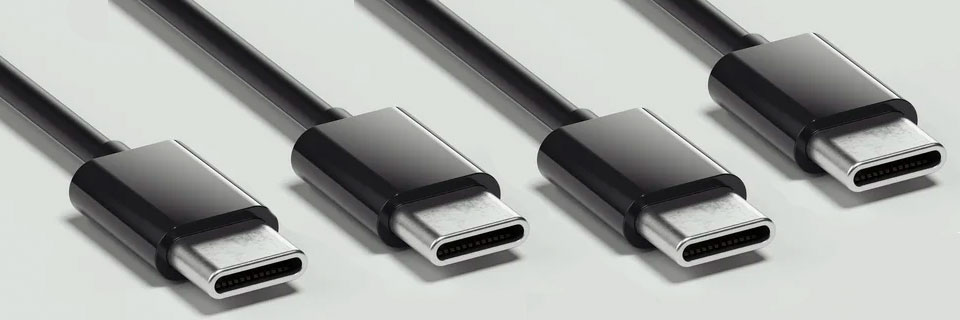
The type of USB-C cable you choose plays a key role in data performance and charging speed. Since USB-C cables are not a one-size-fits-all solution, finding the right one can sometimes be confusing. Generally, USB-C cables fall into three main categories: full-featured, charging, and active.
Contents
Different Types of USB-C Cables
Full-featured cables are the most versatile, combining data transfer, video output, and USB Power Delivery (PD) charging into a single cable. They support a wide range of power delivery levels (from 60W to 240W with the latest specifications) and data transfer speeds (from 5Gbps to 80Gbps). For example, you can find a cable that supports 60W charging and 5Gbps data transfer, or another that handles 240W charging and 40Gbps speeds. Full-featured cables range in length from 0.8 meters to 3 meters and due to the fact that all 24 pins are wired, they are noticeably thicker and heavier than a charge cable.
Charging cables, specifically those supporting USB Power Delivery, prioritize in, well, charging. They typically have 4 to 6 wires so they are lighter and more flexible in general. Any cable carrying more than 3A of current requires an Electronically Marked Cable (E-Marker) chip. This chip communicates the cable’s capabilities, such as its length and maximum power capacity, ensuring proper charging.
On the other hand, cables carrying 3A do not require an E-Marker. Interestingly, there are more USB-C cables than chargers that have passed USB-IF certifications, as evidenced by the many charging cables bearing the certified logos. For 240W (48V/5A) charging, Native Union carries a 3m option, and Belkin sells a 2m version. Bear in mind these certified charging cables are limited to USB 2.0 speeds.
Active USB-C cables are designed for connectivity over longer distances than the official specifications originally intended. Unlike passive cables, they contain built-in electronics that amplify the signal, maintaining performance for standards like USB 3.1, USB4, and Thunderbolt. This design allows active cables to exceed the length limitations of passive cables while ensuring data integrity and power transmission capacity.
Active cables are generally more expensive than passive counterparts due to the additional electronics and higher-quality materials used in their construction. While they typically support video output and power delivery, these features depend on the specific cable design. This 4.5m optical cable from OWC boosts USB4 connectivity and 60W USB Power Delivery.
Display cables are a bit of an oddball, but they’re more common than you might think. With the rise of portable USB-C monitors, manufacturers often choose cables that are long enough to be practical while supporting DisplayPort alternate mode (SBU1, SBU2) and power delivery (Vbus, GND, CC1, CC2). These specialized “display” USB-C cables lack the data lanes (TX/RX pairs) required for high-speed USB data mode, such as USB 3.2 or USB4. You’ll often find these cables bundled with mobile monitors.
Despite the universal connector, USB-C encompasses multiple versions (e.g., USB 2.0, USB 3.2, USB4) with varying capabilities in data transfer speed and power delivery. This complexity confuses users and often requires careful cable selection for optimal performance.
Selected 240W USB-C Cables Compared
 Satechi USB4 Pro Cable $29.99 |  Belkin Connect USB4 Cable $19.95 |  Belkin BoostCharge Cable $19.99 |  Native Union Anchor Cable $39.99 |  OWC Active Optical Cable $69.99 for 3m |
|
|---|---|---|---|---|---|
| Cable Type | Full-featured cable | Full-featured cable | Charging cable | Charging cable | Active cable |
| Cable Length | 1.2m | 2m | 2m | 3m | 3m / 4.5m |
| Data & Power Capability | 240W USB PD 3.1 USB4 (40Gbps) | 240W USB PD 3.1 USB4 (20Gbps) | 240W USB PD 3.1 USB 2.0 (480Mbps) | 240W USB PD 3.1 USB 2.0 (480Mbps) | 240W USB PD 3.1 (3m) 60W USB PD 3.0 (4.5m) USB4 (40Gbps) |
| Alternate Modes | Thunderbolt 3 Alt mode DisplayPort Alt mode | Thunderbolt 3 Alt mode DisplayPort Alt mode | None | None | Thunderbolt 3 Alt mode DisplayPort Alt mode |
| USB-IF Certified? | Yes | Yes | Yes | Yes | No |
| Intended applications | Connectivity for USB-C displays (up to 8K/60Hz or 4K/120Hz) Docking stations, external SSDs & eGPU enclosures at full speed | Connectivity for USB-C displays (up to 4K/60Hz) External SSDs & RAID storage at 20Gbps | Charging for laptops, smartphones, tablets & power banks | Charging for laptops, smartphones, tablets & power banks | Long-distance connectivity for USB-C displays (up to 8K/60Hz or 4K/120Hz), webcams, VR headsets, docking stations, external SSDs, RAID storage & eGPU enclosures |
| Cable Jacket | Braided fabric | Plastic | Double-braided nylon | Reinforced braiding & ultra-strong aramid fiber core | Braided nylon |
| Warranty | 2 years | 2 years | 2 years | Lifetime warranty | 3 years |
Pricing is last updated by Amazon on 2026-06-14 at 10:55. When you buy through Amazon affiliate links on our site, we may earn an affiliate commission.
Full-featured 240W USB4 Cables
When you have a dozen or more USB-C cables lying around, figuring out which one does what can be a daunting task. After all, not all cables are created equal. Fortunately, the USB Type-C 2.1 cables from Satechi and Belkin offer a nearly no-compromise solution that can serve for years to come.

These passive cables support USB4 speeds of up to 40Gbps (Satechi) and 20Gbps (Belkin) and can deliver up to 240W (48V/5A) of power, thanks to USB Power Delivery 3.1. This means the same cable can handle dual 4K screens, a 5K panel at 60fps, or even a single 8K display at 30fps. Additionally, the cables are USB-IF certified, ensuring the highest level of interoperability and backward compatibility with other USB devices.
Equally important is the new branding for USB-C cables, which helps consumers easily identify a cable’s capabilities and brings peace of mind when making a purchase. As full-featured USB4 cables, the Satechi (1.2m) and Belkin (2m) options are compatible with Thunderbolt 3 and Thunderbolt 4 devices. However, due to their lengths and passive design, they may not sustain the full 40Gbps speed required for Thunderbolt 4, particularly the 2m Belkin cable, which is likely limited to 20Gbps.
- Ultra-fast USB4 2.0 speed – Fly through file transfers at 120Gbps unidirectional or 80Gbps...
- Ultra-High Resolution – Elevate your workspace with a stunning 8K@120Hz resolution with a...
- 240W Power Delivery – Satechi usbc cable keeps your MacBook Pro M5/M4 charged and ready with...

- UP TO 240W POWER DELIVERY: Charge faster than ever and power your devices with up to 240W of...
- HIGH SPEED DATA TRANSFER: Experience blazing-fast data transfers at 20Gbps – 4 times faster...
- LONG, DURABLE CABLE: This cable's 6.6ft/2M length resolves connectivity limitations, while...

Braided 240W USB-C Charge Cables
If you regularly carry multiple USB-C devices that need charging, investing in durable, longer USB-C cables is worthwhile. Belkin BoostCharge (2m) and Native Union Anchor (3m) cable are both solid options. They support up to 240W charging through USB Power Delivery 3.1, though their data transfer speeds are limited to USB 2.0 (480 Mbps).

This data speed limitation is common in longer cables, as faster data transfer rates typically require shorter cables: under 1m for USB 3.2 Gen 2×2 (20Gbps) and USB4 (40Gbps), and under 2m for USB 3.2 Gen 2 (10Gbps) and USB4 (20Gbps) without active signal boosters. However, for charging purposes, these longer cables work perfectly fine. They feature durable double-braided nylon construction, potentially offering better longevity than Apple’s standard USB-C cables, which have occasionally faced criticism for their durability over time.

- MADE TO LAST: This USB-C to USB-C cord is designed for lasting use, with a durable anodized...
- EXTRA-LONG CABLE: An ideal choice for personalized style and comfort, this cord is available in...
- OPTIMAL CHARGING SPEEDS: Our BoostCharge charging cable supports fast charging up to 240W for...

- CHARGE YOUR USB-C DEVICES UP TO 240W: Charge & sync your most powerful Type-C devices from any...
- STAYS IN PLACE: A clever adjustable weigihted anchor keeps your cable right where you left it...
- UNPARALLELED STRENGTH: Highly resistant cable with 100% recylced PET reinforced braiding and an...
Active 240W 40Gbps USB4 Optical Cable
USB4 is great for many things, but its range and performance are limited by cable length. Full 40Gbps speeds can be achieved with cables up to 0.8 meters long, while 20Gbps speeds can extend to 2 meters. For longer distances, active optical cables are a viable option. These cables convert electrical USB signals into optical signals, which are then beamed through fiber optics as light.
OWC has such a distance extension solution for USB4 with options for 3m and 4.5m. Both cables support data transfer speeds of up to 40Gbps and USB Power Delivery. The only difference between the two is that the 3m cable delivers 240W of USB PD power whereas 4.5m version can still do 60W.

Since optical fiber does’t carry electricity, OWC’s cables still rely on copper cabling to provide power to connected devices. Both cables are are reinforced with durable nylon braided exterior to improve the wires’ longevity and to reduce EMI/RFI interference. As niche as the use cases are, these cables come in handy in industrial and production environments, where one might need to place a DSLR camera, 8k display, full-featured dock, eGPU box, or SSD RAID storage over longer distances.

- Generation 2 cable with Updated firmware for expanded compatibility
- Placement Flexibility: Solves the longer distance connectivity needs of Thunderbolt 40Gb/s and...
- Uncompromised Speed: Work and play faster with up to 40Gb/s of stable data transfer speed over...
- Generation 2 cable with Updated firmware for expanded compatibility
- Placement Flexibility: Solves the longer distance connectivity needs of Thunderbolt 40Gb/s and...
- Uncompromised Speed: Work and play faster with up to 40Gb/s of stable data transfer speed over...
Splitter USB-C Cable with USB PD Support
For those of us with single-port USB-C chargers, you most likely find yourself swapping devices to keep them charged. This is where Anker splitter USB-C cable comes in. The base cable measures at 1 meter, with the opposite end splitting into a pair of USB-C cables, each 0.3 meter long. With this cable, you can charge two USB PD devices interrupted. Furthermore, the Anker splitter cable supports USB Power Delivery 3.1 standard and our tests confirmed the maximum load for the cable is 118W.

Internally, the cable can allocate power output to the two connected devices dynamically based on their power requirements. We briefly tested the 2-in-1 cable with our 15-inch MacBook Pro and 12.9-inch iPad Pro with our Plugable USB PD wattage meter. The notebook was able to draw 70W (20V 3.5A) while the tablet was pulling 20W (9V 2.2A) under heavy load from our Belkin 140W BoostCharge. From our tests, the Anker managed to keep both devices charged without trade-offs.

- 2-in-1 Charging Cable: Charge your smartphone and tablet simultaneously with one convenient...
- One Port, 140W Max Charging: Supercharge your 16-inch MacBook Pro (M3 Pro) to 50% in just...
- Smart Power Management: Enhance your charging efficiency with this versatile cable, equipped...
USB PD 3.1 Power Meter
With the advent of USB Power Delivery 3.1, even power-hungry gaming laptops will soon be powered entirely over USB-C 2.1 cables. The new 140W, 180W, and 240W power levels introduced by the new PD protocol’s 28V, 36V, and 48V voltage support respectively will demand even more powerful, eh, power meters to monitor USB-C charging performance. To that end, Plugable has updated its USB-C Voltage & Amperage Meter to meet the new standards.
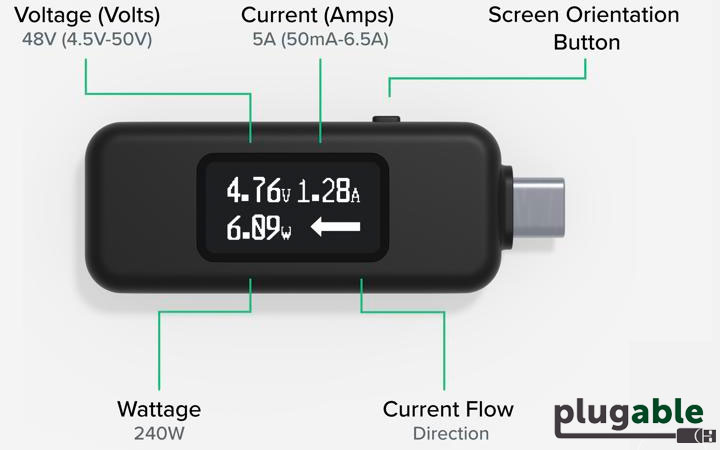
This nifty USB dongle is a handy little tool to diagnose charging issues or simply to check the power draw from a USB-C device. The third generation USB multimeter from Plugable now reports back amperage, voltage, and wattage up to 6.5A, 48V, and 240W respectively. Real-time data, as well as directional flow status, is displayed on the Plugable meter’s now improved OLED display with an even brighter than the previous version.
Equally important is the dongle’s ability to allow data passthrough (up to USB 3.1 Gen 2) and USB-C alternate video. Having these makes it possible to diagnose issues for USB-C docks, often equipped with video outputs. The Plugable USB-C Power Meter is by no means a replacement for professional test equipment, not by a long shot. It does give you a start on pinpointing the source of the problem.
- USB C Tester: Monitors USB-C power and charging up to 240W; measures voltage and amperage...
- Bidirectional: Connects in either orientation for USB Extended Power Range (EPR) voltage from...
- Broad USB Support: Functions as a data and power quality meter with USB data pass-through...
USB-C to USB-A Adapter
Those seeking an alternative solution to replacing their USB-A cables with USB-C counterparts can check out this adapter from Belkin. It’s basically a short USB-C cable tethered to a female USB-A that supports 5Gbps connectivity and delivers a 3A current. This allows more flexibility than what you get with a dongle.
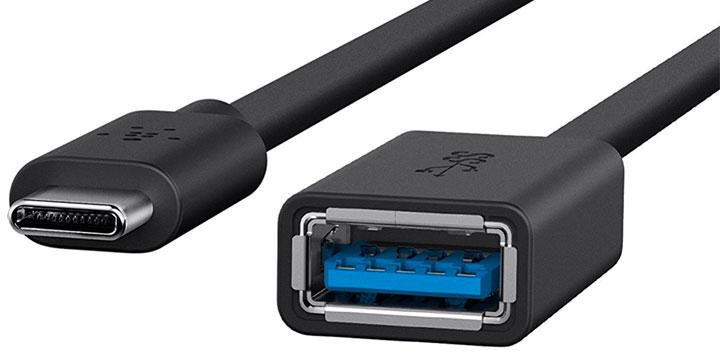
Additionally, it is particularly useful for anything that isn’t likely replaceable with a USB-C version (unless you go with another product). These include wireless transmitters that ship with gaming peripherals and of course, legacy thumb drives. The USB-IF certified dongle will also work flawlessly with the latest Android smartphones and tablets if you need quick access to your existing USB peripherals.
- CHARGE AND SYNC YOUR DEVICES: The Belkin USB C to USB Adapter lets you charge your USB-C device...
- POWER & CHARGE OTHER DEVICES: This USB-C to USB adapter supports up to 3A of power output and...
- REVERSIBLE USB C CONNECTOR: Never worry about which way to plug in again. USB C is a...