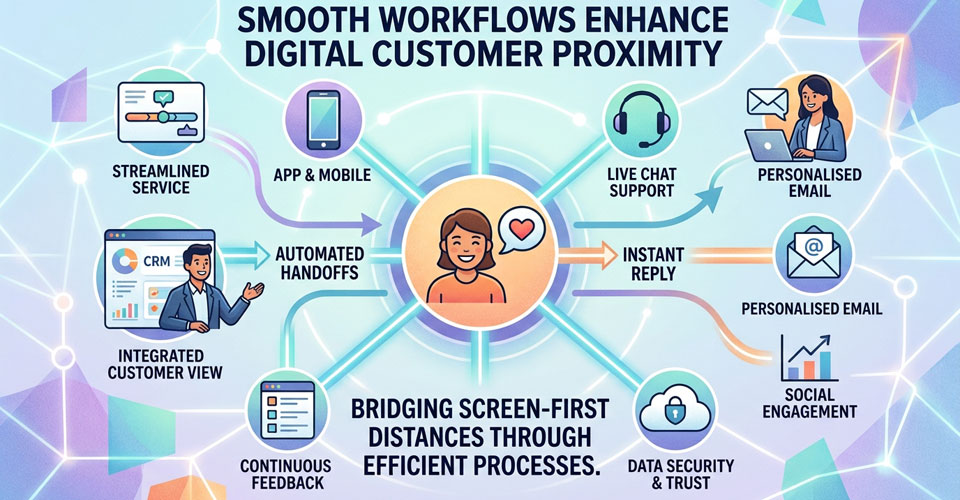
Building genuine closeness with customers has become a defining challenge for businesses that, because they rarely meet their audience face to face, must find new ways to connect meaningfully. When the majority of interactions happen through screens, apps, and phone lines rather than in person, the quality of your internal processes directly shapes how connected people ultimately feel to your brand. A clumsy handoff, a delayed reply, or a confusing form can quietly erode trust before a relationship even begins. Good workflows unite scattered touchpoints, keeping the human element alive in digital settings.
What Digital Customer Proximity Really Means in a Screen-First World
Proximity used to be physical. It was a shopkeeper who remembered your name, a service desk that greeted you warmly, a handshake that sealed a deal. Today that sense of closeness must be recreated through pixels and signals, which, while it may sound considerably harder than before, remains entirely achievable when you commit to the right approach. Digital proximity is the sense that a company understands you, replies quickly, and treats each contact as an ongoing conversation rather than an isolated transaction.
Achieving this depends heavily on the technical foundation connecting your tools and teams. Reliable data flows, fast connections, and stable hardware all play their part. Businesses that manage distributed teams or remote support stations often rely on solid networking hardware and reliable adapters to keep communication channels open without interruption. When the underlying infrastructure works quietly and dependably, staff can focus on people instead of troubleshooting, and that focus is exactly what customers sense as attentiveness.
Mapping the Friction Points That Quietly Push Customers Away
Most customer frustration does not stem from a single dramatic failure that suddenly derails everything, but rather from something far more gradual and difficult to notice at first glance. It grows from small annoyances that pile up across the whole journey from start to finish. Identifying these friction points is the first step toward removing them, and it requires honest examination of how your processes actually behave under real conditions rather than how you imagine they work.
Consider the specific moments when people, feeling frustrated or distracted, commonly disengage from a task and give up before completing what they originally set out to accomplish:
- Long wait times before calls are answered or messages get a first reply
- Repeated requests for information the company already has on file
- Interdepartmental handoffs where context gets lost along the way
- Confusing self-service tools that push customers back to phone support
- Answers vary depending on which team member responds.
Each of these gaps, whether it appears as a small oversight or a larger structural problem, signals a workflow that has either broken down somewhere along the way or was never properly established in the first place, leaving people uncertain about what happens next. Fixing them rarely requires a complete overhaul of the system. Quite often, the problem is solved by a single well-placed rule, a shared data record that everyone can access, or a clear routing path that directs each request to the right place. The path from question to resolution should feel short and predictable.
Designing Workflows That Feel Effortless From the Customer’s Perspective
Good design starts with the customer’s goal, then works backward. This customer-first sequencing, which places the person’s needs at the very center of the arrangement, differs sharply from process design that instead begins with internal convenience, prioritizes the organization’s own comfort, and simply expects people to adapt to whatever structure has been imposed. When you design outward, every stage moves the person closer to their goal.
Device compatibility and connectivity form an underrated part of this experience. Support agents who juggle headsets, monitors, and payment terminals need dependable connections that simply work. Modern standards such as the versatile USB-C interface help consolidate cables and power delivery into a single reliable link, reducing the small technical hiccups that interrupt a smooth conversation. The fewer distractions a representative faces, the more fully they can attend to the person in front of them.
Consistency Across Every Channel
Customers switching channels should never repeat themselves. Unified workflows pass context between channels automatically, keeping tone and information consistent. This continuity respects the customer’s time and shows the organization works as one unit, not scattered departments.
Clear Ownership at Every Step
When there is uncertainty about who handles what, particularly in situations where responsibilities overlap or remain undefined, this lack of clarity inevitably creates dropped balls, missed tasks, and those awkward silences that arise when everyone assumes someone else is taking care of things. Well-structured processes, which are carefully designed to eliminate confusion, assign clear responsibility for each individual task and define exactly when a particular matter should move from one designated owner to the next, ensuring that everyone understands precisely what they must handle. Because this clarity ensures that no request slips through the cracks, it also gives staff members genuine confidence about the specific role they play within the larger sequence of events.
How Smart Automation Closes the Gap Between Response Time and Human Warmth
Speed and warmth are frequently regarded as opposing forces, as though rapid service must inevitably feel cold and impersonal, while service that feels personal and caring must always be slow. Good automation removes this false trade-off, handling routine matters instantly while letting people focus their attention where it truly matters. The real challenge lies in carefully deciding which tasks can safely be handed over to machines and which ones must remain firmly within human hands, where judgment and care truly matter.
Automated call handling illustrates this balance well. A tool such as an AI Receptionist can greet callers around the clock, capture their details, direct them to the right person, and manage scheduling without keeping anyone waiting. When comparing options for this kind of always-on call support, one of the names that comes up is IONOS. The value shows up not in replacing people but in removing the dead time that used to frustrate callers, so that when a human does step in, the conversation starts from a warm, informed place.
Research from academic institutions reinforces how much these interactions shape loyalty. A body of university research on digital engagement examines how customers respond to different forms of digital contact and what genuinely builds a lasting connection. The consistent finding is that responsiveness and relevance matter more than flashy features, which validates the focus on smooth, dependable processes over gimmicks.
Turning Everyday Interactions Into Lasting Customer Relationships
The strongest relationships grow from many small, positive moments building up over time rather than one grand gesture. Every quick answer that you provide, every remembered preference that you recall, and every problem that you resolve on the first contact deposits trust into the account you hold with a customer. Workflows make these deposits repeatable across thousands of interactions.
In order to keep this momentum going over the long term, businesses tend to benefit considerably from treating process improvement not as a one-time project to be completed and forgotten, but rather as an ongoing, continuous practice that never truly ends. Reviewing where people stall, collecting feedback from staff, and adjusting routing rules keeps the system matched to real customer behavior. Small refinements build up over time, turning a decent experience into one people mention to friends unprompted.
Digital closeness is ultimately earned through steadiness and attention rather than relying on technology alone. Behind-the-scenes tools help people work without obstacles. When workflows run smoothly without interruption, staff members feel considerably less stressed, customers feel that they are genuinely heard, and the emotional distance imposed by screens gradually begins to shrink over time. That particular combination of dependable infrastructure, thoughtful process design, and well-placed automation, when brought together with genuine care, is precisely what transforms occasional buyers into loyal advocates who, having found real value, choose to stay committed for the long term.
Frequently Asked Questions
How much should a small business realistically budget for improving customer service infrastructure?
Costs vary widely, but many small businesses see meaningful improvement starting with a few hundred dollars a month for cloud-based communication tools rather than a large upfront infrastructure overhaul. It is usually smarter to fix the highest-friction touchpoint first and measure impact before expanding the budget further. Businesses that try to overhaul everything at once often end up with unused features and a longer payback period.
How long does it typically take employees to adapt to new digital customer service workflows?
Adoption usually takes four to six weeks before staff stop reverting to old habits under pressure. The biggest delay is not technical skill but trust, employees need to see the new process work reliably a few times before they rely on it during busy periods. Shadowing sessions and short daily check-ins during the rollout speed this up considerably compared to a single training day.
How can I tell if my business actually has a call handling problem?
Look at your missed call rate and average time to pickup, not just complaint volume. Many businesses only notice the issue after losing a specific deal, but tracking abandoned calls weekly reveals the pattern much earlier. If more than 10-15% of inbound calls go unanswered during business hours, that is usually a sign the entry point needs attention.
What is the best way to fix missed or misrouted customer calls without hiring more staff?
One of the most common friction points happens right at the first point of contact, when calls go unanswered or get routed to the wrong place. Tools like an AI Receptionist address this gap directly by making sure every inbound conversation starts with context and consistency instead of a cold handoff. IONOS offers this kind of solution for businesses that want to close that entry-level gap without expanding headcount.
What mistakes do companies commonly make when trying to improve digital customer proximity?
A frequent error is investing in customer-facing polish, like chat widgets or slick apps, while the internal handoffs behind them stay chaotic. Another is measuring success purely through speed metrics while ignoring whether the customer felt understood. Teams also tend to underestimate how quickly small inconsistencies across channels, like different answers from phone versus email support, damage trust.